Startup Weekend: How to Take a Company From Concept to Creation in 54 Hours by Marc Nager & Clint Nelsen & Franck Nouyrigat
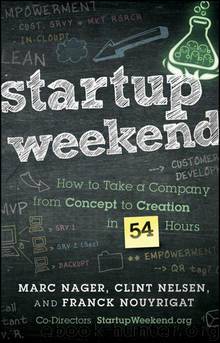
Author:Marc Nager & Clint Nelsen & Franck Nouyrigat [Nager, Marc & Nelsen, Clint & Nouyrigat, Franck]
Language: eng
Format: epub
ISBN: 9781118105092
Amazon: 1118105095
Publisher: Wiley
Published: 2011-11-07T16:00:00+00:00
So You Have a Viable Idea—Now What?
Once you have something that looks like a viable idea, it's time to quickly refine and prioritize. What is the most important aspect of this product? There are at least two schools of thought at Startup Weekend on this question. Some people say the most important thing is to build something during the course of the weekend. Indeed, many Startup Weekend participants are builders by nature and by profession. They come because it's fun to build—and to build quickly. They want to test the limits. And they feel like unless you can give customers something to try out, you won't know how to move forward with your business. One of the guys who believed in this very strongly built a system that would complete the conference calling function described in Chapter 2. You simply schedule a call in your Google calendar, and all of the phone numbers on the list would be called and then connected at the appointed time. He demonstrated exactly how it worked for everyone on Sunday night.
The other school of thought is that you need only come out of the weekend with a well-developed idea. Just put up a website offering an idea for a new product or service and ask people if they'd like to buy it. Get people to sign up and tell them you'll let them know when it's ready. Then you'll have some clue about what people want and you won't even have to waste the energy and time and money on building it. This is what business theorists call a proof of concept.
We encourage people to go one step further at Startup Weekend and build what's called a minimum viable product. Rather than just having a website that shows people what the product will do once it's built, go ahead and build a stripped down version of it. As one of the pioneers of this theory, Eric Ries, explained in an interview with Venture Hacks, “The idea of minimum viable product is useful because you can basically say: Our vision is to build a product that solves this core problem for customers . . . we think that . . . early adopters [of] this kind of solution will be the most forgiving. And they will fill in the features that aren't quite there in their minds if we give them the core, tent-pole features that point [in] the direction of where we're trying to go.”
Dan Rockwell, who has launched a number of startups and participated in a Startup Weekend in Columbus, Ohio, offers a concise way of thinking about minimum viable products: They should be products with the minimum value, the minimum desired experience, the minimum cash lost, the minimum BS to endure—and the maximum momentum to burn.
Rockwell's company, Big Kitty Labs, produces something called Protobakes, which are “functional code examples” of something you want to make at the level of a minimum viable product. He sees these protobakes as a means of facilitating conversation between you and your team, as well as your customers and your investors.
Download
This site does not store any files on its server. We only index and link to content provided by other sites. Please contact the content providers to delete copyright contents if any and email us, we'll remove relevant links or contents immediately.
Pioneering Portfolio Management by David F. Swensen(6305)
Man-made Catastrophes and Risk Information Concealment by Dmitry Chernov & Didier Sornette(6026)
Zero to One by Peter Thiel(5808)
The Motivation Myth by Jeff Haden(5216)
The Miracle Morning by Hal Elrod(4734)
Elon Musk by Ashlee Vance(4130)
Unlabel: Selling You Without Selling Out by Marc Ecko(3668)
The Art of Persistence: Stop Quitting, Ignore Shiny Objects and Climb Your Way to Success by Michal Stawicki(3662)
Delivering Happiness by Tony Hsieh(3433)
Urban Outlaw by Magnus Walker(3403)
Purple Cow by Seth Godin(3208)
The Marketing Plan Handbook: Develop Big-Picture Marketing Plans for Pennies on the Dollar by Robert W. Bly(3070)
Mastering Bitcoin: Programming the Open Blockchain by Andreas M. Antonopoulos(3050)
The Power of Broke by Daymond John(2992)
The Content Trap by Bharat Anand(2928)
Applied Empathy by Michael Ventura(2911)
The Airbnb Story by Leigh Gallagher(2862)
Keep Going by Austin Kleon(2768)
Radical Candor by Kim Scott(2726)
